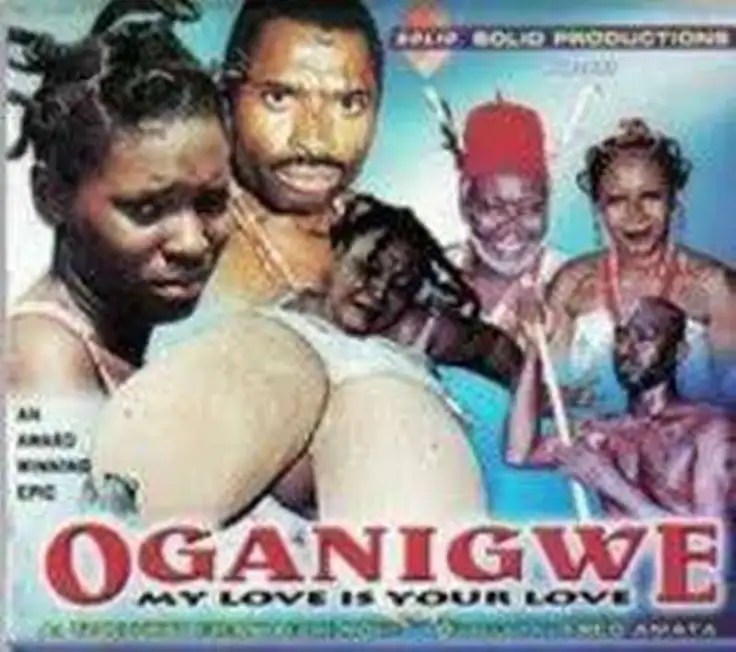
Dir: Fred Amata | Story: Uzochukwu Ezeanyaeche | Screenplay: Joe Dudun, Adim Williams, Aikay Osunbor
Main Cast: Chiege Alisigwe, Camilla Mberekpe, Kenneth Okonkwo, Steph-Nora Okere, Amaechi Muonagor.
Do you remember Oganigwe?
Everybody who was alive in 1999 remembers Oganigwe. The film stands now as a cultural meme for the freakishly enlarged penis. If you don’t get the reference, this is your cue to go watch it!
What most people remember about Oganigwe is the divine retribution visited on the film’s villains—the moment the eponymous Oganigwe, supreme god of the fictional Umuoga, arises and strikes humiliating punishment on the bodies of the people who wronged Olamma, the film’s heroine. These scenes have overshadowed everything else in the popular memory of the film, making us forget that, underneath all of that, Oganigwe could have been a love story.
The bush path
The film opens on a bush path on which Prince Onyema (Kenneth Okonkwo) and the tattered orphan Olamma (Chiege Alisigwe, in a debut role) meet. The prince is charmed; the orphan is not. The prince wants to chat; the orphan doesn’t—she has an incensed and (literally) murderous stepmother, Ijego (Camilla Mberekpe), waiting at home. ‘My mother will beat me if I don’t come back on time,’ she says to the prince as she flees from him.
This scene sets the stage for the rest of the story.
You see, the prince of Umuoga is unmarried. He has become a headache for his parents. Several maiden dances have been held in his honour and he has selected nobody for a wife.
Days after he sees his mystery orphan, a fourth dance is arranged.
Ijego’s daughter Ada (Steph-Nora Okere) will be there, but Olamma will not be allowed to go. However, Olamma sneaks her way to the square to witness it.
And that is the second time the prince sees her—and picks her as his bride. In doing so, he unknowingly elevates two domestic problems (his hitherto wifelessness and Olamma’s maltreatment under her wicked stepmother) into matters of state.
The performances
Mberekpe’s turn as Ijego shows a woman for whom anyone in her way is a problem to be removed. There is something almost instructional in the way she speaks, unhurried and pointed, that makes her cruelty feel considered rather than impulsive. The film’s scorching feel is all down to her.
Alisigwe’s performance is unsteady across scenes. At her best, in non-speaking moments, she plays Olamma’s suffering with heartbreaking sorrow, but it is in the speaking scenes that the illusion falls apart, and she is unable to carry dialogue and body-language-expressed sorrow at the same time.
There are moments where she seems unsure of her footing on camera—where she appears to need reassurance to deliver, and where the natural authority of the more experienced performers around her—Mberekpe, Okere, and Okonkwo—drowns her then-tender skill.
Okonkwo’s Prince Onyema is written as a catalyst rather than a full person. Despite his impressive lordly status—and gait—he exists to develop Olamma’s character and Umuoga’s problems later on, which he does well, but to the detriment of his own character. The role does not demand much of him; the world does not demand much of him besides the hectic task of bride selection.
Perhaps the most endearing performance is Ugochukwu Okoh’s, as Ikem, Ijego’s young son. He is a contrast and reproach to his cruel mother and sister Ada. He is Olamma’s only ally in the household. He brings childlike innocence and rebellion to his interpretation.
What I Loved (& Didn’t)
In Oganigwe, there are no wide shots of Umuoga. There is no huge sense of Umuoga—its people, its history, and its relations to other Igbo communities—in the story. I mention this because the characters’ journeys take them to other (unnamed) lands beyond Umuoga. And yet the characters seem to exist in cellular worlds with their private troubles, only coming together often enough to connect one another’s separate conflicts. There is a moment in the film when the chiefs and king of Umuoga are in council, deliberating a royal scandal: the camera does an orbit shot of the elders, taking away from the tension and gravity of the scene.
That said, the costumes are elegant and detailed; clothing is used to tell clear stories of status, occasion, and changes in circumstance and locale throughout the film.
The score is largely apt, contributes meaning to the story, and its chords are gentle on the ears.
The sound engineering is pretty rough, though; we can hear the wind breathing into the boom mic, there is occasional mismatch between audio and image, and choppy editing—not unusual for the era. Somewhere in the second half, a figure in a red modern dress passes through a scene. A continuity error.
The pacing is mostly great, but there are a couple of places where the story’s logic skips beats. How does Olamma arrive at the realisation that society-wide tragedies impacting random people were connected to the injustices she had suffered? What was the trigger that awoke Oganigwe’s vengeful anger? If he could have meted out his justice on his own, without ceremony, why didn’t he do so much earlier in the story? Why did he let the suffering of the innocent go on so long? Granted, this would have given us only 20 minutes of film. The retribution is enormously satisfying, and yet its hinge is missing, which, in a story whose moral architecture is otherwise so deliberate, feels like an unthought-through.
About the ‘Love Story’…
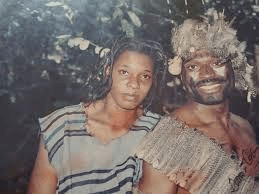
Oganigwe is a love story hidden in a god-of-justice plot. The romance between Onyema and Olamma is budding and unhurried. It deserved more screen time, more development.
It never quite took off, is what I’m saying.
Which is what the promised sequel could have explored, I assume. But it’s been 17 years since that promise, and we are still waiting for Oganigwe pt 2. I’d do an Oganigwe sequel or remake.
Final Verdict
4 stars out of 5.
 The Nollywood Archive
Leave a comment